Introduction
Delivering data to inform effective decision-making across all functions of an agile government

Our goals
Good data is the cornerstone of good decisions. Robust data and evidence provide the information needed for a responsible and accountable government to achieve its performance and wellbeing goals.
Delivering the right data to the right people at the right time sets the foundation for decision-makers to improve outcomes for the people and communities of NSW.
The NSW Government has created a new NSW Data Strategy to ensure that Government’s data and information needs are met now and into the future. The Strategy builds on the achievements of the inaugural 2021 NSW Data Strategy and extends Government’s vision for data use that meets information needs, embraces and adapts to new technologies, ensures high standards of safety, security and accountability and supports building a better NSW.
Extensive research was undertaken to inform the Strategy’s development. Initial research included a jurisdictional review of NSW, Australian and international data and digital strategies and roadmaps, and a scan of data-related legislation and regulations. These scans revealed six macro trends in NSW that align with national and global challenges and opportunities which shape the current environment. These trends include:
- Emerging technology
- Governance, privacy, security
- Embedding data into decision-making
- Sustainable capability
- Data for community and place
- Maximising value through data sharing
Further qualitative and quantitative research was conducted through interviews with stakeholder representatives including government, industry and academia, cross-agency working group meetings, and guidance from the NSW Data Leadership Group (NDLG), ongoing consultations with stakeholders, and an initial data maturity assessment (further discussed under Mission 4).
These findings helped to frame the Strategy within the NSW Government data landscape, identify the gaps, and the actions needed to achieve a future state that better supports the delivery of Government’s information needs and priorities. The research and gap analysis informed the design of the Strategy’s guiding principles, focus areas, missions, directions and commitments.
The inaugural NSW Data Strategy aimed to enhance the way the NSW Government uses data to drive better outcomes for the community, building on cross-sector collaboration, data use and sharing practices established during the COVID-19 pandemic. This has resulted in increased revenue and cost savings, productivity, and further enhanced government’s transparency, inclusion, and trust with community.
Examples include:
- $202M in estimated avoided costs forecast to be saved by Schools Infrastructure NSW by using the Spatial Digital Twin, which enables faster planning, design and reduced costs of major projects by connecting disparate data sets
- ~$30M in savings by obtaining insights through a centralised data platform and analytics model, helping agencies to avoid consulting and ICT spend
- 150 senior leaders across the sector receiving curated insights reports to inform decision making on priority issues such as cost of living, housing and affordability, night-time economy, tolls, and disaster recovery and preparedness
- Faster and cheaper insights on priority issues, such as a fairer rental market, using government’s internal capability compared to external consulting (resulting in approximately 6 x faster and typically 30-50% cheaper insights)
- 60 days saved by 162 users on powerful insights from large, linked datasets via the NSW Journey Lab, a set of interactive and easy-to-use dashboards
- Providing students and staff with a safe, secure and productive learning environment using a department-owned generative AI tool in schools, ensuring students are not exposed to harmful or inappropriate content
- 51% increase in open data since 2020, resulting in 2 days saved per public enquiry through the Data.NSW Open Data Dashboard
- Empowering community co-governance through the National Disability Data Asset pilot test cases, linking jurisdictional and Commonwealth data to better support people with disability, their families, and carers
The new NSW Data Strategy builds on these achievements by enhancing government’s data maturity and data capability to better support the information needs of Government now and in the future. It further extends government’s vision for data use through the Strategy’s five focus areas, leveraging trends and opportunities, while ensuring strategic alignment across government.
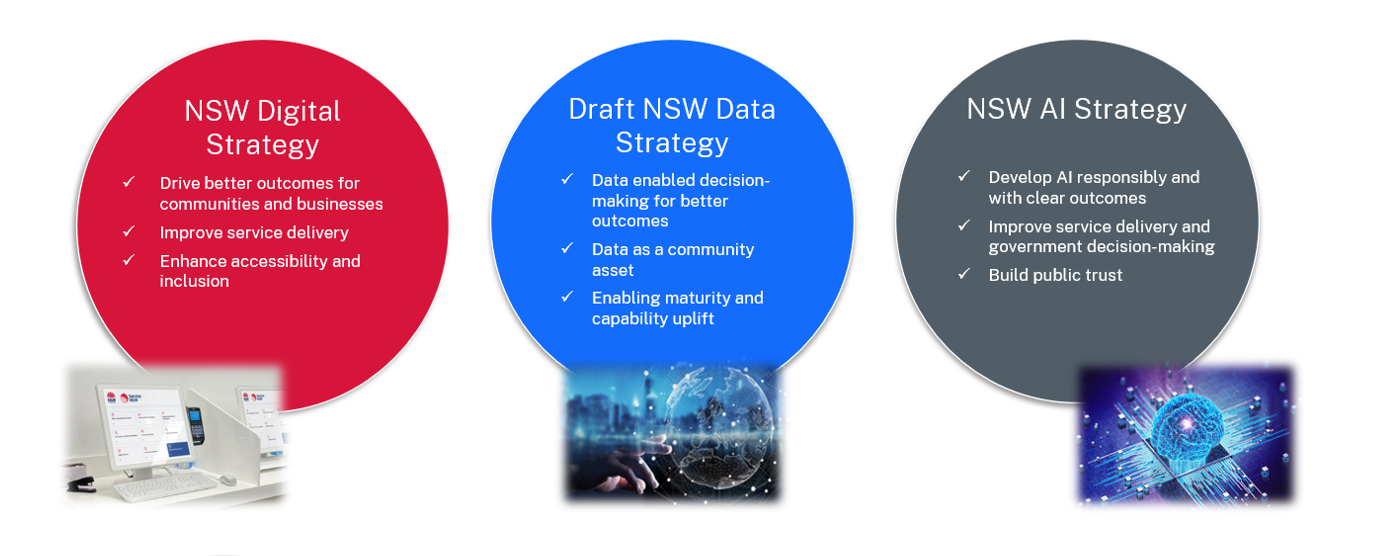
The NSW Data Strategy has been developed to align and work in concert with the NSW Digital Strategy1 and NSW Artificial Intelligence Strategy2. Together, these strategies set out the pathway for a strong, agile and inclusive data and digital future for NSW.
The NSW Government has identified three inter-related data information needs. Each of these need areas collects, uses and shares information for different purposes and priorities, and each operates in a unique context with its own challenges and opportunities.
- Agency or domain specific information needs: refer to demands for service delivery and administrative data relevant to the portfolio and generation of insights to meet operational and performance measurement needs.
- Whole of government information needs: refer to informing cross-sector policy priorities and ensure we have a better understanding of how effectively government delivers services.
- Community and place-based information needs: refer to requirements on government to meet evidence needs of specific community, industry, or regionally defined groups. Communities have increasing expectations to be able to access data to inform local solutions and inform decision making for better outcomes.
The seamless flow of information for and between these information need areas can be enhanced by improvements in data quality, standards and systems, as well as common, streamlined data governance practices and access requirements, where possible. Building interoperability and connection between each, enhances the depth and breadth of insights that can be drawn from data assets, enabling a fuller view of complex issues, the needs of communities and impactful solutions.
The Strategy was developed to facilitate uplift in each of the areas of information need, with a particular focus on whole-of-government and community and place-based need areas. The Strategy has been designed to facilitate and increase engagement across the three areas to deliver fit-for-purpose data and insights.
Data is a powerful tool to improve the lives for the people of NSW. Quality data and insights are essential at each stage in the design and delivery of programs and services that improve performance and wellbeing.
Using data effectively in this way necessitates a high level of data maturity. The Strategy seeks to uplift data maturity to deliver short-, medium- and long-term benefits across the three information needs: community or place based, agency or domain specific, and whole of government.
These three information needs are inter-related and enhancing quality and maturity in one area benefits all.
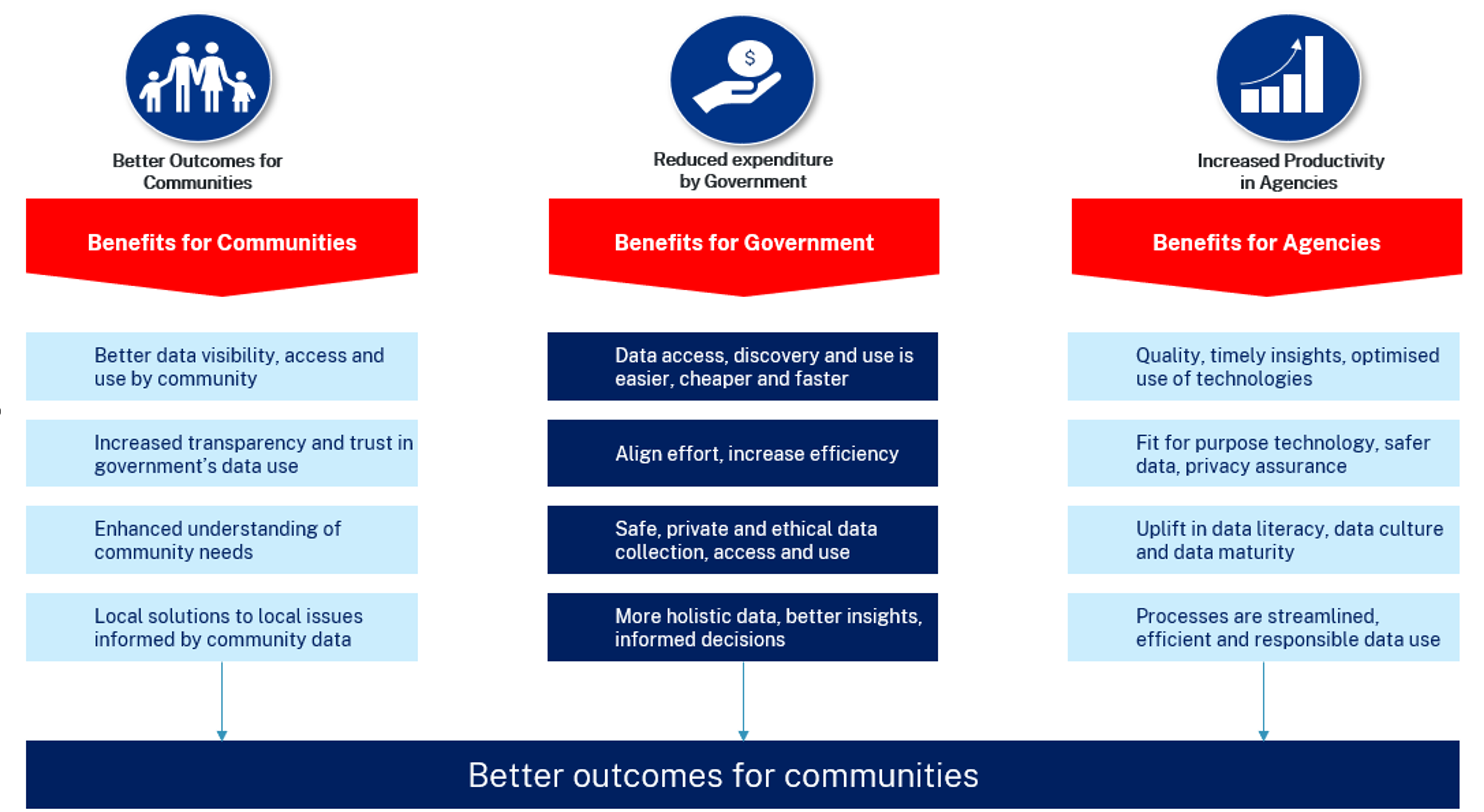
A set of guiding concepts and principles were used to develop this Strategy. These concepts and principles were informed by research including jurisdictional and legislative reviews, stakeholder consultation, and a data maturity assessment.
The Strategy’s missions, directions, and commitments are all shaped by and aligned to these principles.
The guiding principles and concepts are:
- Data is at the heart of government’s decision-making
- Data safety, privacy ethics and accountability are fundamental
- Data sharing and reuse adds value and delivers better insights
- Community outcomes improve when governments engage and share data with communities
- Coordinating data practices improves quality and productivity
- Inclusive data practices give voice to marginalised groups and deliver more accurate community insights
The Strategy is centred around five focus areas – each representing an overarching outcome the Strategy seeks to achieve. Each focus area has an associated mission statement, directions and a set of commitments.

Five Focus Areas
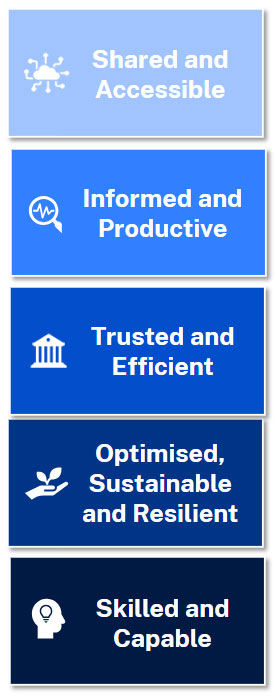
Five missions
| Mission 1: | Share data for more meaningful insights |
| Mission 2: | Deliver data for better outcomes |
| Mission 3: | Build community trust through safe and efficient data practices |
| Mission 4: | Build agile and optimised data systems |
| Mission 5: | Uplift data capability in our workforce |
The Strategy is accompanied by a selection of case studies. The case studies showcase how government’s advanced data practices are already supporting and shaping the delivery of critical government services and priorities.
Implementation of the strategy will occur across three horizons. Implementation of the commitments will be prioritised in consideration of priority of need, feasibility and capacity to leverage and build on existing resources and initiatives. See the Data Strategy Roadmap for more details.
Throughout implementation, deliverables will be generated that are targeted to:
- Building maturity and capability to deliver on information needs at the agency specific level
- Providing resources, platforms and systems that are common (shared) and used on an opt in basis across government
- Developing policies, infrastructure and practices that are core (mandatory) and used consistently across government.
The progress and impact of the Strategy will be measured as it is implemented. A program logic approach has been used to identify short-, medium- and long-term outcomes to be achieved by the Strategy. A monitoring and evaluation plan will:
- Define, monitor, review and evaluate outputs, outcomes and progress
At regular intervals during the Strategy’s implementation, short-term outcomes for each Mission will be measured via a comprehensive set of qualitative and quantitative metrics using multiple data collection methods.
- Update and realign the Strategy
At the mid-point of implementation, the Strategy will be reviewed, updated and adjusted to inform Treasury’s decision making. The review will update on cross-sector capability and maturity and identify needs and priorities for the next phase of the Strategy.
- Review achievements against intended medium- and long-term outcomes
At the end of the implementation period, the Strategy will be reviewed and evaluated. The Strategy achievements will be documented alongside the intended outcomes.